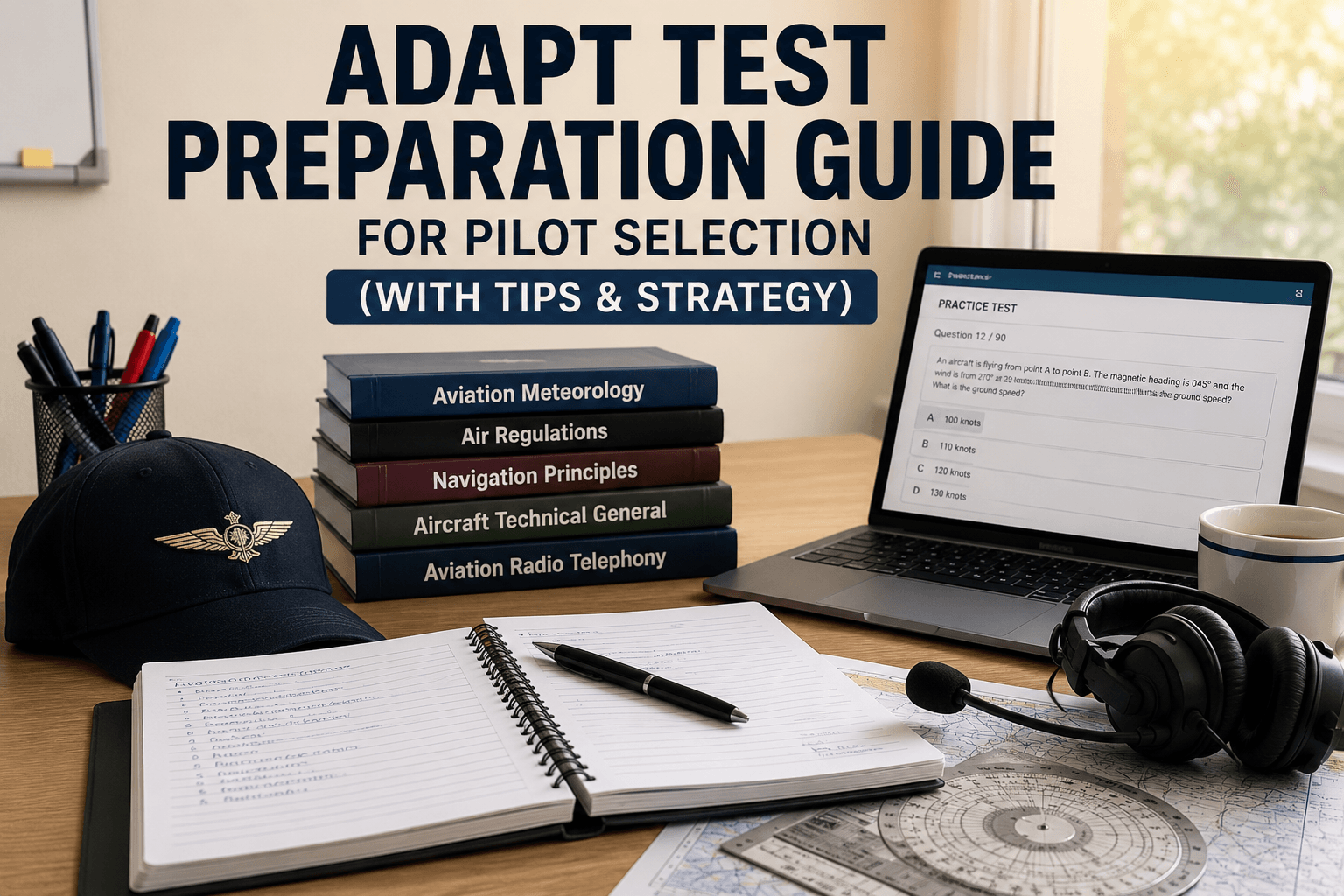
You’ve worked hard to accomplish the task of getting to the flight deck. The last thing stopping you from wearing that crisp pilot uniform is the ADAPT test (Aviation Domain Adaptability and Psychometric Test). We know it can be intimidating to take a test with so much riding on it for such important things such as a job application to a cadet program with a company like IndiGo or at a high caliber flight school. However, an IQ test is not the sole purpose, it provides the examiners insight into how your brain is able to perform in a busy environment, just like flying in the cockpit. In this guide, we will go through all the areas included in the ADAPT test such as hand/eye coordination and how to avoid the “out-of-place” type of questions and how to give yourself the best chance of success by having a strategy that allows you to have the confidence equivalent of a pilot who has all the shipping experience in the world when you arrive for your assessment.
Symbiotics has created the ADAPT system, which is made up of several levels of digital assessment. The ADAPT digital assessment system is the way airlines around the world use it to help companies assess their “pilot potential.” Where a math exam typically doesn’t test you on how you deal with information when you are under stress, the ADAPT system is specifically created to look at whether you can operate a multi-million dollar aircraft (in the air) while communicating with air traffic control and managing a failure in the aircraft’s system.
The Core Components
If you want to succeed on your test you have to know your “adversary”. Elements of the ADAPT assessment are divided into these five categories:
FAST (Future Aptitude Selection Tool)- The ultimate in multitasking. You will be asked to deal with a dynamic task in the environment (usually a joystick), while you’re asked to answer cognitive questions.
Cognitive Reasoning- This category assesses your ability to do mental math, verbal reasoning and spatial reasoning (for example: if the airplane turns 90 degrees to the left where would the sun be at that point).
Control and Coordination- Commonly referred to as “ball game.” You will use a joystick and/or rudder pedals to keep a moving object on target. It requires smooth and precise adjustments.
Aviation Knowledge- Basic principles of aviation physics and aerodynamics. You would not be called on to be an engineer, but you should have an understanding of basic aviation principles such as Bernoulli’s law.
Personal Characteristics Questionnaire- A deep psychological investigation of your characteristics (i.e, traits such as leadership, resiliency and willingness to take risks) in relation to the ICAO standards for pilot competencies.
Proven Strategies for Success
1. Master the Art of Multitasking
Your FAST test will overload you with tasks. Getting tasks done is not about being perfect at one thing; it is about being competent at everything. If you do not allow any of your focus to be placed on the joystick and then only use your ears to give you cues, you are not going to pass.
Strategy: Learn to “scan”. As pilots do with the instruments in front of them, you should move your eyes across the display in a defined pattern. Do not “tunnel” your eyes through the hardest task.
2. Sharpen Your Mental Math
You will not have a calculator available to you (in the cockpit; therefore, also not on the test). You should be able to calculate variables related to speed, distance, and time instantly.
Tip: Every day perform at least 2 minutes of practice for the calculations above. For example, if a plane flies at 180knots, in 10 minutes how far has he/her traveled? If you can arrive at 30 statute miles in under three seconds, you are on the right path.
3. The “Smooth” Coordination Rule
Many candidates become stressed and “excessively” control the joystick to cause jerky motions when they go through the coordination stage.
Tip: Use the joystick as if it were a sensitive instrument rather than a video game controller. Apply a small, smooth force to operate the joystick correctly. If the ball moves right on the screen, press gently on the joystick in a leftward motion to keep in line (do not slam down). During the coordination phase, many candidates panic and “over-control” the joystick, making jerky movements.
Preparation Roadmap: 4 Weeks to Takeoff
Week
Focus Area
Action Plan
Week 1
The Basics
Review Grade 10 to 12 Math and Physics
Week 2
Cognitive Skills
Use Brain training apps for spatial awareness and pattern recognition
Week 3
Psychomotor
Practice with a flight sim or joystick. Get used to the inverted Y-axis
Week 4
Full Mocks
Take timed practice ADAPT tests to build test stamina.
Navigating the Personality Section
Airlines can identify competency based on yes/no indicators. For instance, the evaluation for CRM (Crew Resource Manager) will include; being aware of safety, being part of a team, and following the correct procedures.
Be Consistent: The test uses five different ways to ask questions. If you answer question 5 saying you “calmly handle things” and then answer question 50 with “frustrated easily”, this would identify a disconnect between your self-understanding and other people’s observations.
Think Like a Captain: The most important aspects to consider are safety, teamwork, and following the Standard Operating Procedures (SOPs).
Conclusion: Your Flight Starts Here
“It’s strongly recommended that candidates prepare for the ADAPT-Test on their own with discipline, consistent effort, mental calmness, and the use of a game plan. While the computerized tasks may seem overwhelming at first, they are skills that can be improved upon with appropriate instruction and practice.As an example, Narain Aviation has the capability to take an aspiring aviator from beginner to professional in the airline industry. Consequently, we have focused our efforts on the development of individualized Modules for the preparation of ADAPT candidates that include personalized coaching to help you successfully pass through the selection process with success. So don’t just “wing it” — get ready for success by preparing with Narain Aviation and making your move towards the cockpit.”
FAQs
Is the ADAPT test really that hard, or is it just hype?
It’s not “hard” as in difficult calculus, but more so intense in nature. The reason it is hard is the speed and multitasking needed. Think about a math word problem, while balls are being thrown to you (like tennis balls) that you have to catch. That effort is a way to measure your “brain bandwidth”. After doing this over time, your brain will adapt to this weight; then it becomes much easier.
Do I need to be a pro at video games to pass the coordination part?
Not always; although gamers usually have a slight advantage when it comes to hand-eye coordination. The test uses a joystick; however, the goal is precision and stability, instead of fast moving your fingers over buttons (“button mashing”). If you can keep your hand steady while making little intentional changes to the joystick you will pass the test.
Can I actually study for the personality test?
Although no one can “study” for this, you can prepare. Your goal isn’t to trick the test, it’s to know what a “Pilot Mindset” is. Airlines want to know if you are dependable; if you can follow regulations, procedures, rules of conduct (SOP), and how you operate with others. The best way to prepare is by reading about ICAO Pilot Competencies, so that you have an understanding of what type of traits they are looking for, before you answer questions.
What happens if I mess up one section? Is it game over?
No! The analysis is based on a weighted average across all sections. So if your math is decent/average but your motor skills and ability to multitask are incredible then you have a strong chance of being hired. Recruiters are generally interested in having a complete candidate. The biggest mistake candidates make is using one low section score to negatively affect their performance in the next. Acknowledge the low score and move on!
Fill the Details Below & Get a Free Guide on How to Become a Pilot.
He had served in the Meteorological Branch of the Indian Air Force for over 25 years. He not only has had years of experience in operational weather forecasting across the country but had also served in the capacity of Joint Director involving administrative and policy matters.
He was part of IPKF in Sri Lanka and served during various operations. He was actively involved in issuing timely forecasts for cyclones over Kutch and during earthquake at Bhuj.
He has deep knowledge of Meteorology and forecasting based on years of experience having served in most parts of the country. This practical knowledge mixed with years of teaching experience is very helpful in his current assignment.
Besides all of the above, he has had the opportunity of teaching Met for over five years to young trainee pilots at flying academies in Bidar and Hakimpet. At these places, young trainees from Fighter and Helicopter stream were trained to become pilots’ in the Indian Air Force.
A Squadron Commander in the IAF, she has handled the responsibilities of a Senior Air Traffic Controller, Radar Controller and a Duty Air Traffic Controller. She was the operational and administration head for more than 70 personnel in a squadron, which included officers and airmen.
Implementation of Airport procedures and enforcing field rules and regulations at diverse IAF bases with varied traffic conditions.
Successfully handled Aircraft operations as Senior Air Traffic controller at busy Air Force bases like Tezpur, Jodhpur, Bidar and Hakimpet which have complex flying environments, handling mixed traffic of defence as well as civil airplanes.
Successfully delivered results while working under challenging conditions and resource constraints. Possesses the ability to integrate and motivate diverse teams by creating positive work environment to facilitate high grade performance.
A retired fighter pilot, with versatile experience of 30 yrs. in the IAF, comprising Flying Training primarily, Operations and Flight Safety, apart from Surface to Air Missiles and Radars.
Over 17 yrs as a pilot, including second-in-command of a Flying Squadron. Total Flying of 2,350 hrs (4000 sorties), on Maruts, MiG-21s, Kirans, HT-2s and HPT-32s. Have force-landed aircraft without engine power twice, as a trainee (jet trainer aircraft) and as an Instructor (propeller trainer aircraft).
Qualified/Chief Flying Instructor twice at the Air Force Academy, 900 hrs instructional flying with trainees. Chief Ground Instructor at AF Stn Bidar, handling all Ground Training for flying
Commander of a Missile Squadron of 375 technical, operational and support personnel, for 3 yrs. Best Guided Weapons Squadron twice, 1997-98 and 1999-2000.
Director/Senior Flying Training Officer at HQ Training Command IAF, Bangalore for 5 yrs. Responsible for induction and operations of Hawk Advanced Jet Trainers and Flight Simulators at Bidar, Flying Instructors’ School at Tambaram and Surya Kiran Aerobatic Team (SKAT).
Qualified Flying Instructor, trained at Flying Instructors’ School, Tambaram, Chennai(1990) Second in Flying and fifth in overall merit at commissioning.
Air Marshal Ravinath Gururaj Burli (Retd) has a distinguished record of four decades of service. He has been an instructor at Flying Instructors School (FIS), Tactics And Combat Development Establishment (TACDE), Defence Services Staff College (DSSC).
He was Commandant at Air Force Academy (AFA), Dundigal, where he trained the young air force cadets learn flying training.
He brings his immense knowledge to train young students at our institute in Navigation, Instruments and Radio aids. His passion for teaching is amazing and fabulous.