If you’ve ever looked up at an airplane in the sky and thought about how great it would be to be in that plane instead of sitting at a desk, there has never been a better time to do something about it. The Indian aviation industry is currently undergoing a huge “hiring boom,” with airlines placing thousands of new aircraft orders & all airlines searching for qualified pilots to fly these new aircraft. If you’re just a fresh holder of your CPL or have years of flying experience and are looking for your next flying job, your first step in achieving your dream of working as a professional airline pilot is to read this article and understand, “Airlines Hiring Pilots in India (Latest Available Positions & Requirements),” as major airlines such as IndiGo & Air India & Up-and-Coming Airlines such as Akasa Air have many opportunities available for the right people!
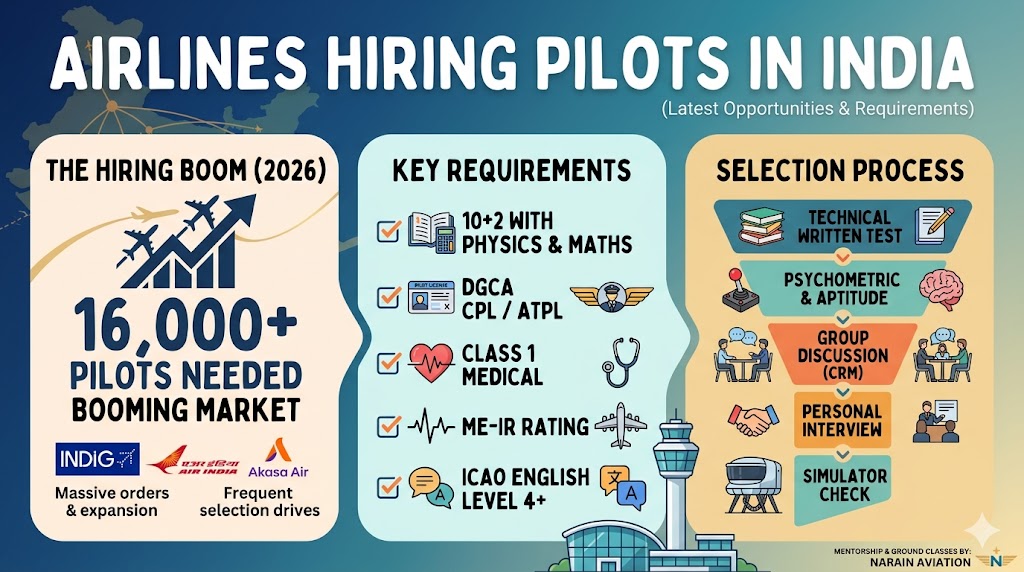
The aviation industry in India is growing extremely quickly. Airlines have placed multiple airplane orders, with thousands of new aircraft for delivery from both Boeing and Airbus, which translates into a large requirement for new pilots.
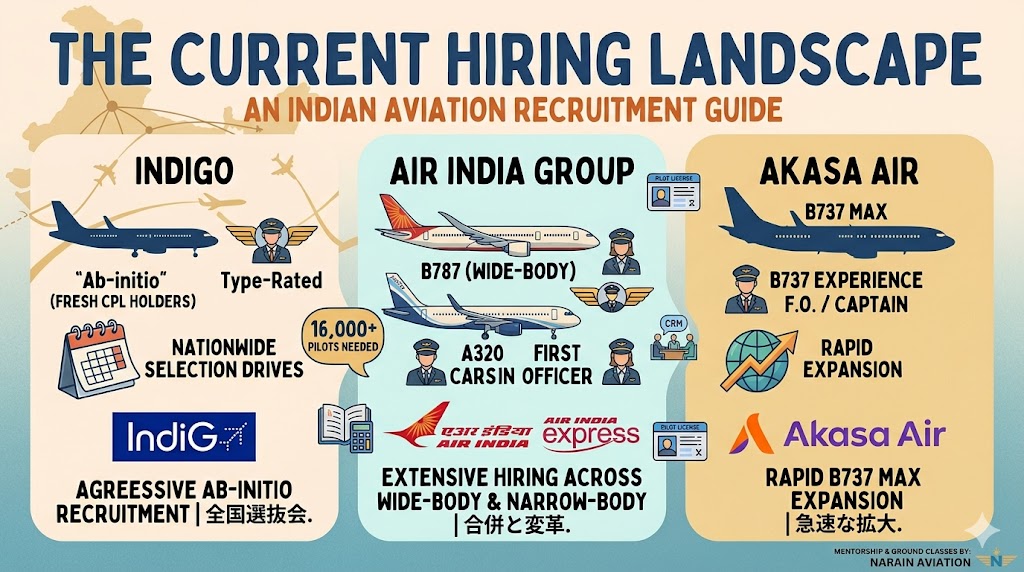
IndiGo will need to recruit a large number of pilots over the next few years, approximately 16,000 new pilots including both ‘Ab-initio’ (new) pilots and type-rated pilots as they rapidly expand the A320 fleet through large nationwide selection drives.
The Air India group includes several airlines within their newly merged and restructured operation. Air India will need to hire a lot of pilots for their separate narrowbody and widebody A320 and B777/B787 fleets as well as for Air India Express (B737) in order to support the continued expansion of their low-cost carrier operation.
Akasa Air is the newest addition to the aviation marketplace and will be expanding their fleet of B737 MAX aircraft, while continuing to hire First Officers and Captains via rolling recruitment for the foreseeable future.
General Eligibility & Requirements
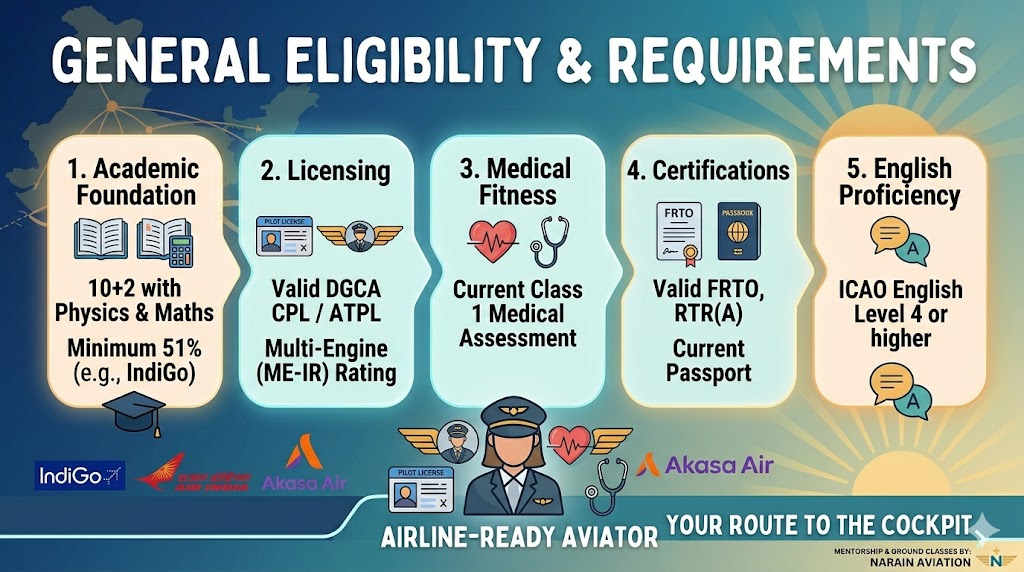
There are different ‘flavours’ of selection by airlines but the basic requirements for becoming a First Officer with any airline are the same:
Academic Basis: Successful candidates will have passed 10+2 with Physics and Maths, and in most cases, meeting IndiGo’s requirements of 51% or greater is acceptable.
Licences: A valid Commercial Pilot Licence (CPL) or ATPL from the Directorate General of Civil Aviation (DGCA) is a must, as well as an ME-IR (Multi-Engine Instrument Rating) or similar.
Medical: A current Class 1 Medical Assessments (MTA) issued by the DGCA is needed.
Documentary Evidence: Valid FRTO (Flight Radio Telephone Operators License), RTR(A) (Restricted Radio Telephony A) or Flight Radio Telephone Operators and a current Passport.
English Level: ICAO English Language Proficiency (ELP) rating of 4 or greater.
The Selection Process: What to Expect
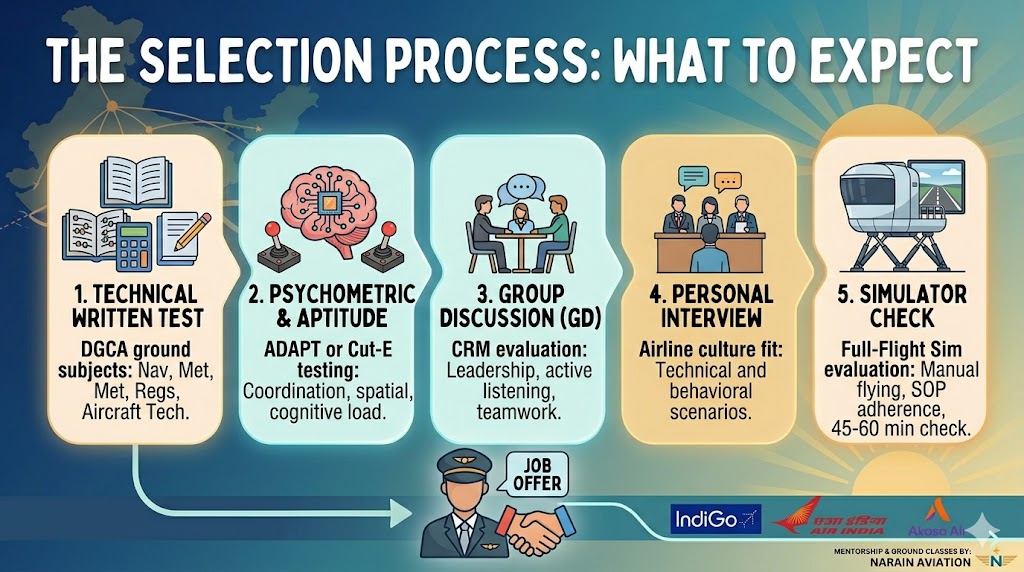
Airlines are searching for professionals who are prepared to join the airline, as opposed to simply pilots who can fly an airplane. Most airlines put their applicants through the following selection funnel:
Technical Written Test – Which assesses the candidate’s knowledge of aviation, including Air Navigation, Meteorology, Aviation Law and Regulations, Technicalities of each Aircraft Type (Maintenance Issues/Limitations) and Safety Procedures.
Psychometric/Aptitude Testing – Which typically assess candidates’ hand-eye coordination and spatial awareness, as well as their ability to manage cognitive load (using platforms such as ADAPT or Cut-E).
Group Discussion (GD) – This is a test of candidates’ Crew Resource Management (CRM) skills, with a focus on leadership, active listening, and teamwork abilities.
Personal Interview – This is a panel interview focusing on candidates’ technical knowledge and their behaviours in various scenarios.
Simulator Proficiency Check – This is a 45-60 minute evaluation conducted in a Full Flight Simulator to assess the candidate’s manual flying ability and adherence to Standard Operating Procedures (SOP).
Conclusion
Getting from being a student pilot to sitting in the captain’s seat is a marathon, not a sprint. With all of the current industry tailwinds, your dream is now more achievable than ever before; however, it takes a lot of preparation and guidance. Your progress towards your final job offer starts with passing your DGCA ground school to completing your simulator training. If you are ready to fly but need a clear path to work through the requirements for becoming a pilot and how to succeed in your airline interview, the experts at Narain Aviation are committed to helping mentor the future of Indian pilots by making sure that they are flight ready from the first day they enter the flight school.
FAQs
I didn’t take Physics or Maths in 12th grade—is my pilot dream over before it started?
Don’t worry! You’re not alone in feeling this way. If you were in either the Arts or Commerce stream throughout your school years then you can still qualify as long as you do the two subjects via NIOS and pass with the required % (typically 51%) to get back into the game. This is a minor setback, but not the end of your chance to pursue an airline career.
I see ‘Type Rating’ mentioned everywhere. Do I really need to pay for that myself to get hired?
There are compelling arguments on both sides of this debate. Many airlines hire people without experience prior to receiving a commercial pilots license but if you have a type rating (on an aircraft such as an Airbus A320 or a Boeing 737) this means you are “airline ready”. Having a type rating may allow you to gain employment sooner than if you did not have one and in many cases may allow you to be exempt from certain initial entrance exams. You could compare this to obtaining a master’s degree instead of a bachelor’s degree; many times having a master’s would make your resume stand out in a large pile.
What exactly is the ’15+10′ rule I keep hearing about for my flying hours?
If you are trying to accumulate 25 hours of multi-engine (ME) time, the majority of the major Indian carriers, especially IndiGo, use this break-down: 15 hours of your ME time must be on an actual aircraft. The most you are allowed to use is 10 hours in a simulator. Ensure your logbook reflects this correctly, as it could cause problems with verification of documents.
I’m 32 years old. Am I too old to start training for a commercial airline job?
No way. Although there’s a cutoff of roughly 30 – 35 years old for cadet programs, you’ll often find airline hiring for First Officership to age 40-45. Airlines place a high value on mature candidates; maturity and life experience are key. You can pursue your goal of flying for an airline as long as you possess a Class I medical certificate; and there are more and more “career changers” flying in the cockpit these days.
Fill the Details Below & Get a Free Guide on How to Become a Pilot.
He had served in the Meteorological Branch of the Indian Air Force for over 25 years. He not only has had years of experience in operational weather forecasting across the country but had also served in the capacity of Joint Director involving administrative and policy matters.
He was part of IPKF in Sri Lanka and served during various operations. He was actively involved in issuing timely forecasts for cyclones over Kutch and during earthquake at Bhuj.
He has deep knowledge of Meteorology and forecasting based on years of experience having served in most parts of the country. This practical knowledge mixed with years of teaching experience is very helpful in his current assignment.
Besides all of the above, he has had the opportunity of teaching Met for over five years to young trainee pilots at flying academies in Bidar and Hakimpet. At these places, young trainees from Fighter and Helicopter stream were trained to become pilots’ in the Indian Air Force.
A Squadron Commander in the IAF, she has handled the responsibilities of a Senior Air Traffic Controller, Radar Controller and a Duty Air Traffic Controller. She was the operational and administration head for more than 70 personnel in a squadron, which included officers and airmen.
Implementation of Airport procedures and enforcing field rules and regulations at diverse IAF bases with varied traffic conditions.
Successfully handled Aircraft operations as Senior Air Traffic controller at busy Air Force bases like Tezpur, Jodhpur, Bidar and Hakimpet which have complex flying environments, handling mixed traffic of defence as well as civil airplanes.
Successfully delivered results while working under challenging conditions and resource constraints. Possesses the ability to integrate and motivate diverse teams by creating positive work environment to facilitate high grade performance.
A retired fighter pilot, with versatile experience of 30 yrs. in the IAF, comprising Flying Training primarily, Operations and Flight Safety, apart from Surface to Air Missiles and Radars.
Over 17 yrs as a pilot, including second-in-command of a Flying Squadron. Total Flying of 2,350 hrs (4000 sorties), on Maruts, MiG-21s, Kirans, HT-2s and HPT-32s. Have force-landed aircraft without engine power twice, as a trainee (jet trainer aircraft) and as an Instructor (propeller trainer aircraft).
Qualified/Chief Flying Instructor twice at the Air Force Academy, 900 hrs instructional flying with trainees. Chief Ground Instructor at AF Stn Bidar, handling all Ground Training for flying
Commander of a Missile Squadron of 375 technical, operational and support personnel, for 3 yrs. Best Guided Weapons Squadron twice, 1997-98 and 1999-2000.
Director/Senior Flying Training Officer at HQ Training Command IAF, Bangalore for 5 yrs. Responsible for induction and operations of Hawk Advanced Jet Trainers and Flight Simulators at Bidar, Flying Instructors’ School at Tambaram and Surya Kiran Aerobatic Team (SKAT).
Qualified Flying Instructor, trained at Flying Instructors’ School, Tambaram, Chennai(1990) Second in Flying and fifth in overall merit at commissioning.
Air Marshal Ravinath Gururaj Burli (Retd) has a distinguished record of four decades of service. He has been an instructor at Flying Instructors School (FIS), Tactics And Combat Development Establishment (TACDE), Defence Services Staff College (DSSC).
He was Commandant at Air Force Academy (AFA), Dundigal, where he trained the young air force cadets learn flying training.
He brings his immense knowledge to train young students at our institute in Navigation, Instruments and Radio aids. His passion for teaching is amazing and fabulous.
 The aviation industry in India is growing extremely quickly. Airlines have placed multiple airplane orders, with thousands of new aircraft for delivery from both Boeing and Airbus, which translates into a large requirement for new pilots.
  There are different ‘flavours’ of selection by airlines but the basic requirements for becoming a First Officer with any airline are the same:
 Airlines are searching for professionals who are prepared to join the airline, as opposed to simply pilots who can fly an airplane. Most airlines put their applicants through the following selection funnel: