Students aspiring to become commercial pilots need to undergo a medical examination to start learning the flying training. They must register for the medical examination and pass it. DGCAneeds all aspiring students to be medically fit to fly, both physically and mentally, in order to ensure their safety during flight.Students have confusion related to the DGCA medical registration process and need to have proper clarity.In this blog, we will talk about the DGCA Medical Registration Process for Aspiring Pilots in India.
The DGCA medical examination is a process that checks the health of the aspiring students. The medical checkup is done by a DGCA-approved medical doctor or facility to decide whether the student is fit medically to be a pilot or not.
Types of DGCA Medical Examinations
In India, there are two types of medical tests checked by the DGCA.
1. Class II Medical Exam
DGCA Class 2 medical examination is given to aspiring students before they start learning the flight training. The medical exam cannot be given at any facility and must be done under the medical facilities that are approved by the DGCA. Click here to start the registration process.
2. Class I Medical Exam
Once approval is granted from a Class II medical exam, the candidate must complete an in-depth Class I medical exam that is needed for the Commercial Pilot License (CPL). The CPL exam is completed by DGCA-approved facilities. Click here to start the registration process.
DGCA Medical Registration: A Process Broken Down
Make Your eGCA Account
Step 1
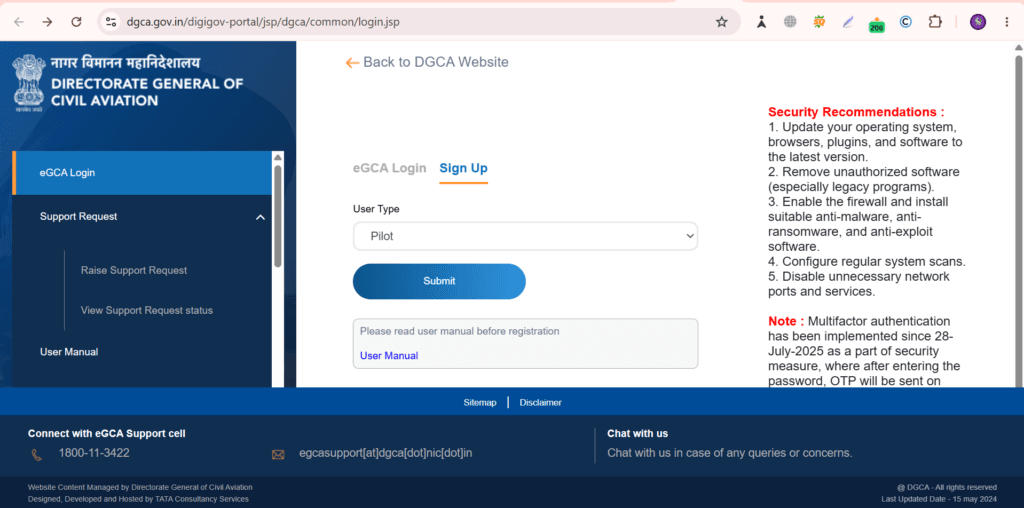
EGCA is an online portal developed by the DGCA that lets students manage their pilot-related applications and formalities. It is essential to register for an eGCA account as it will be required to apply for a Class 1 medical. Make sure you select sign up and then select the ” pilot from the drop-down and click submit.
Step 2
After clicking submit, you will be taken to the following page. select no from the next step to proceed to step 2.
Step 3
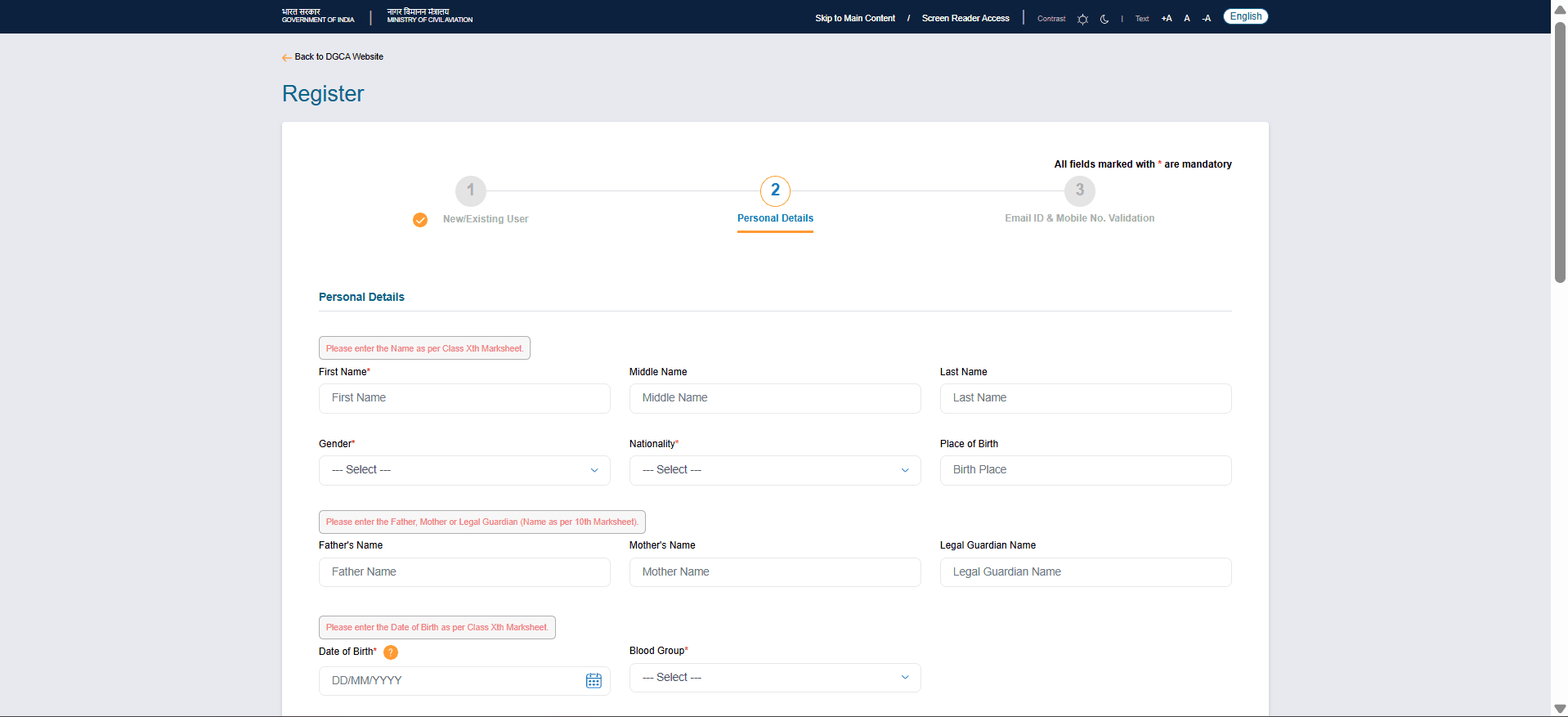
filling in the personal details. You need to fill in the personal details and upload the necessary documents to get your eGCA ID.
step 4
Once the details are submitted, you will get your eGCA ID. Enter the eGCA ID and password on the linkto get into the portal.
Apply for medical registration
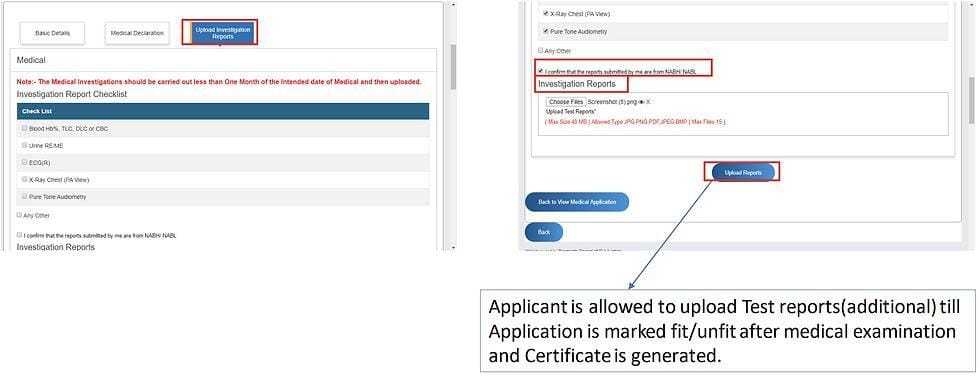
Once your eGCA account is active, you will then be able to submit an application for your Class 2 medical examination.
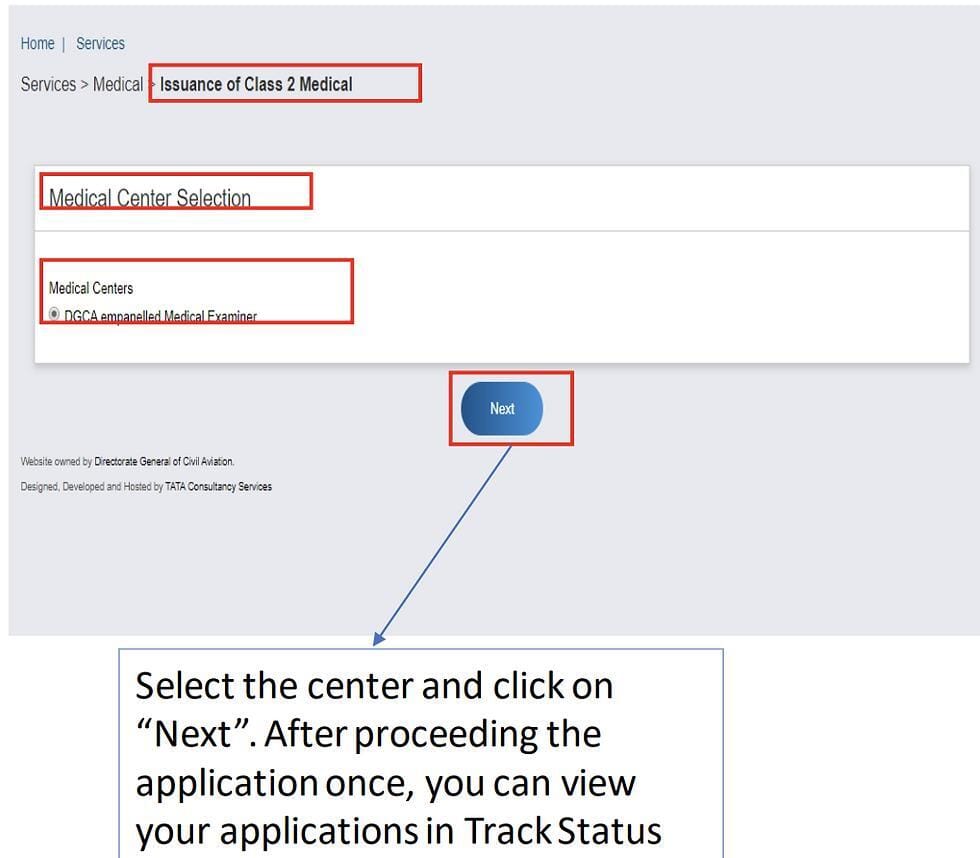
Select the DGCA-approved medical examiner for your medical
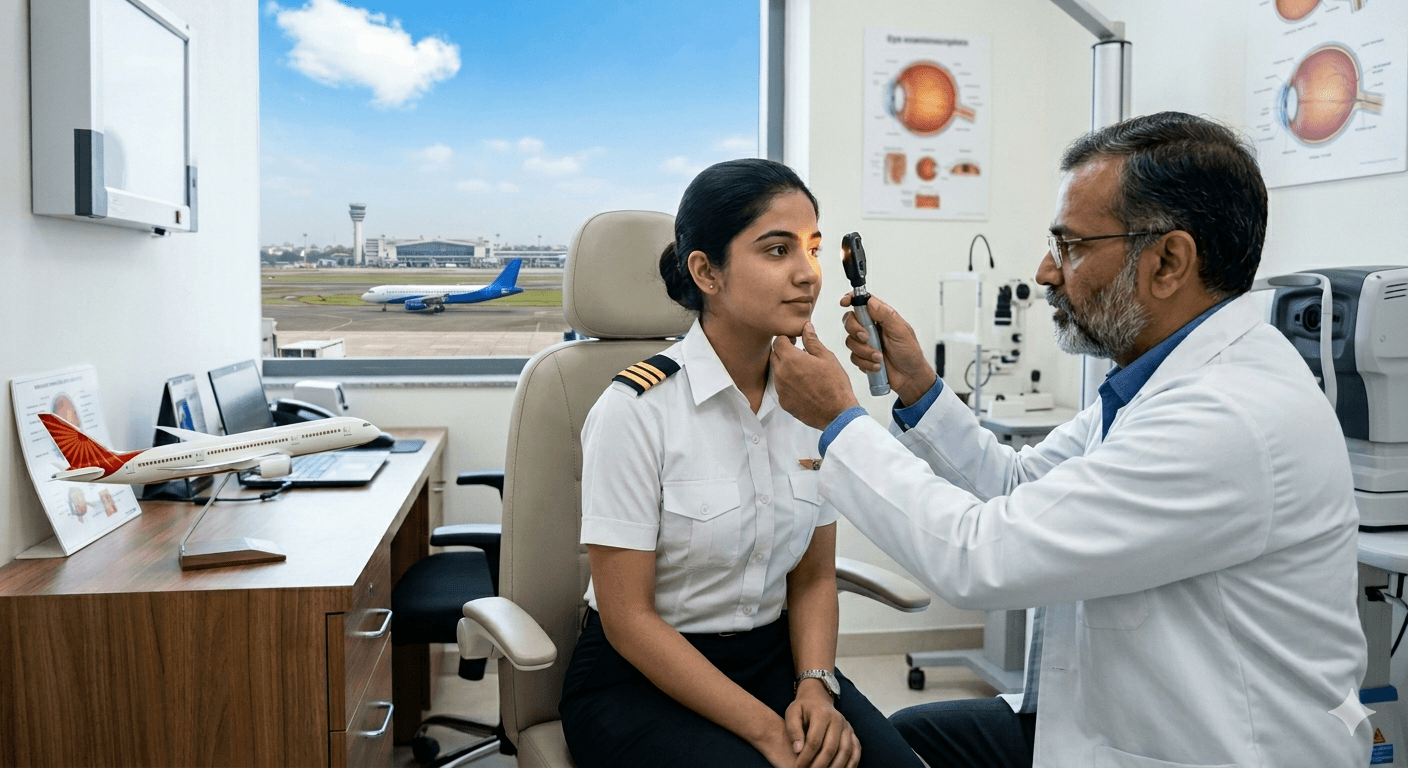
During your Class 2 medical examination, you will undergo the following tests:
Eye examination by a certified optometrist
Colour vision testing
Hearing examination
Electrocardiogram (ECG)
Blood and urine testing
General health check
Receive Your Class 2 Medical Assessment
Once you have successfully undergone your Class 2 medical assessment, the DGCA will issue you with your Class 2 medical assessment. You will be able to check your assessment through the eGCA portal. If you are not medically qualified, you may be required to have further tests or be required to consult a specialist before the DGCA grants you a Class 2 medical assessment. Once you have been granted your Class 2 medical, you will then be able to use this to apply for training as well as for a Class 1 medical assessment.
Apply for Your Class 1 Medical
The next step is to submit an application for your Class 1 medical examination. Similar to your application for your Class 2 medical, you will be able to submit your application through the eGCA portal for approved DGCA centres. Because of the limited availability of appointments, you will need to book your appointment well in advance of your desired examination date.
Reasons for rejection in the DGCA medical exams
Several health conditions can cause aspiring students to be rejected in the DGCA medical exams. Some of the conditions are as follows
If the student has Severe colour blindness
Unmanaged diabetes that can cause issues during flying
If the student has severe heart disease
Hearing issues for the student
If the student has any Neurological conditions.
Procedures for Preparing for the DGCA Medical Exams
You can follow the advice to pass the DGCA medical exams :
Physical fitness
The student must be physically fit to easily follow or manage the physical fitness required in the commercial pilot training and then ob.
Proper sleep
Proper sleep is important for aspiring students to pass the DGCA medical exams.
Don’t Use Alcohol or Tobacco Products
Both alcohol and tobacco products could negatively affect the results of your medical examination, in particular, the health of your lungs and liver.
Make Sure You Have All Required Documents With You
If you are missing one or more documents when you appear for your medical examination, it could result in a delay in processing your application.
Find Out if You Need Any Basic Health Tests Now.
Finding out what your basic health requirements are (e.g., checking your eyes/vision, checking your blood pressure, etc.) ahead of time could save you time on the day of the medical.
Duration of Validity
The duration of medical certificates depends on the age of the pilot and on their type of license, and medical certificates for pilots are renewed at regular intervals as long as the pilot continues to fly legally and has a valid license to fly. Typically, commercial pilots must have periodic Class 1 renewals of their medicals throughout their careers.
Blockquote
A successful aviation career begins with medical fitness, discipline, and proper preparation.
Conclusion
All the aspiring students who want to become commercial pilots must pass the DGCA medical exams. They need to pass them even before they start learning the flying training. Getting your DGCA medical can seem like a lengthy process to complete at first. However, if you prepare properly and have a complete understanding of each area of the medical application process, it can actually be much easier than you think.Narain Aviation is a top commercial pilot training institute that provides the best classes for aspiring students. It helps the students clear the DGCA medical exams and helps them get the commercial pilot license. Feel free to know more about their services.
Contact Details
Flying school – Narain AviationAddress – M-170, 2, 2nd Main Rd, East Of NGEF, Kasturi Nagar, Bengaluru, Karnataka 560043Contact – +91-9148402949WhatsApp – 919945225068E-mail – [email protected]
Frequently Asked Questions
1. Are DGCA medical clearance & approval required for pilot training in India?
Yes, you must have your DGCA Medical Clearance before attending or continuing flight training in India.
2. What is the difference between a Class 1 and Class 2 medical examination?
Class 2 medical exam is conducted before the flying training. Class 1 medical exam is conducted after the flight training is done and before the application for the commercial pilot training.
3. If I wear glasses, can I still be a pilot?
Yes, depending on your vision correction (i.e., glasses) will meet the DGCA medical standard.
4. What will be the timeline for the Class 2 medical exam approval for the student?
It varies according to the student profile and the time it takes for documentation. It can be approved in a few days to weeks.
5. Where do you have to apply for the registration for DGCA medicals?
You can do it through the EGCA portal provided by the DGCA.
6. What will happen if you fail the DGCA medical exam?
The student can go for re-examination or further testing to evaluate their health.
Fill the Details Below & Get a Free Guide on How to Become a Pilot.
He had served in the Meteorological Branch of the Indian Air Force for over 25 years. He not only has had years of experience in operational weather forecasting across the country but had also served in the capacity of Joint Director involving administrative and policy matters.
He was part of IPKF in Sri Lanka and served during various operations. He was actively involved in issuing timely forecasts for cyclones over Kutch and during earthquake at Bhuj.
He has deep knowledge of Meteorology and forecasting based on years of experience having served in most parts of the country. This practical knowledge mixed with years of teaching experience is very helpful in his current assignment.
Besides all of the above, he has had the opportunity of teaching Met for over five years to young trainee pilots at flying academies in Bidar and Hakimpet. At these places, young trainees from Fighter and Helicopter stream were trained to become pilots’ in the Indian Air Force.
A Squadron Commander in the IAF, she has handled the responsibilities of a Senior Air Traffic Controller, Radar Controller and a Duty Air Traffic Controller. She was the operational and administration head for more than 70 personnel in a squadron, which included officers and airmen.
Implementation of Airport procedures and enforcing field rules and regulations at diverse IAF bases with varied traffic conditions.
Successfully handled Aircraft operations as Senior Air Traffic controller at busy Air Force bases like Tezpur, Jodhpur, Bidar and Hakimpet which have complex flying environments, handling mixed traffic of defence as well as civil airplanes.
Successfully delivered results while working under challenging conditions and resource constraints. Possesses the ability to integrate and motivate diverse teams by creating positive work environment to facilitate high grade performance.
A retired fighter pilot, with versatile experience of 30 yrs. in the IAF, comprising Flying Training primarily, Operations and Flight Safety, apart from Surface to Air Missiles and Radars.
Over 17 yrs as a pilot, including second-in-command of a Flying Squadron. Total Flying of 2,350 hrs (4000 sorties), on Maruts, MiG-21s, Kirans, HT-2s and HPT-32s. Have force-landed aircraft without engine power twice, as a trainee (jet trainer aircraft) and as an Instructor (propeller trainer aircraft).
Qualified/Chief Flying Instructor twice at the Air Force Academy, 900 hrs instructional flying with trainees. Chief Ground Instructor at AF Stn Bidar, handling all Ground Training for flying
Commander of a Missile Squadron of 375 technical, operational and support personnel, for 3 yrs. Best Guided Weapons Squadron twice, 1997-98 and 1999-2000.
Director/Senior Flying Training Officer at HQ Training Command IAF, Bangalore for 5 yrs. Responsible for induction and operations of Hawk Advanced Jet Trainers and Flight Simulators at Bidar, Flying Instructors’ School at Tambaram and Surya Kiran Aerobatic Team (SKAT).
Qualified Flying Instructor, trained at Flying Instructors’ School, Tambaram, Chennai(1990) Second in Flying and fifth in overall merit at commissioning.
Air Marshal Ravinath Gururaj Burli (Retd) has a distinguished record of four decades of service. He has been an instructor at Flying Instructors School (FIS), Tactics And Combat Development Establishment (TACDE), Defence Services Staff College (DSSC).
He was Commandant at Air Force Academy (AFA), Dundigal, where he trained the young air force cadets learn flying training.
He brings his immense knowledge to train young students at our institute in Navigation, Instruments and Radio aids. His passion for teaching is amazing and fabulous.



 During your Class 2 medical examination, you will undergo the following tests: