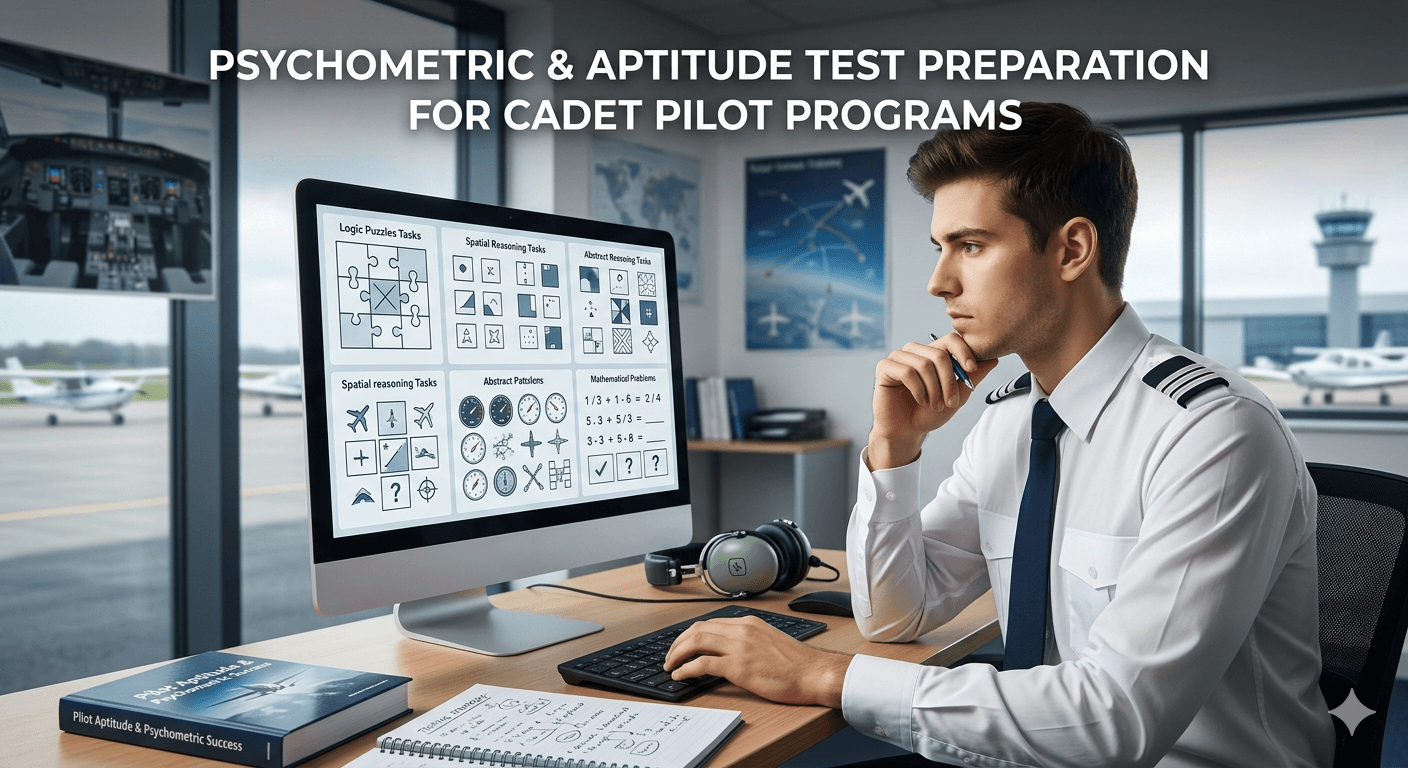
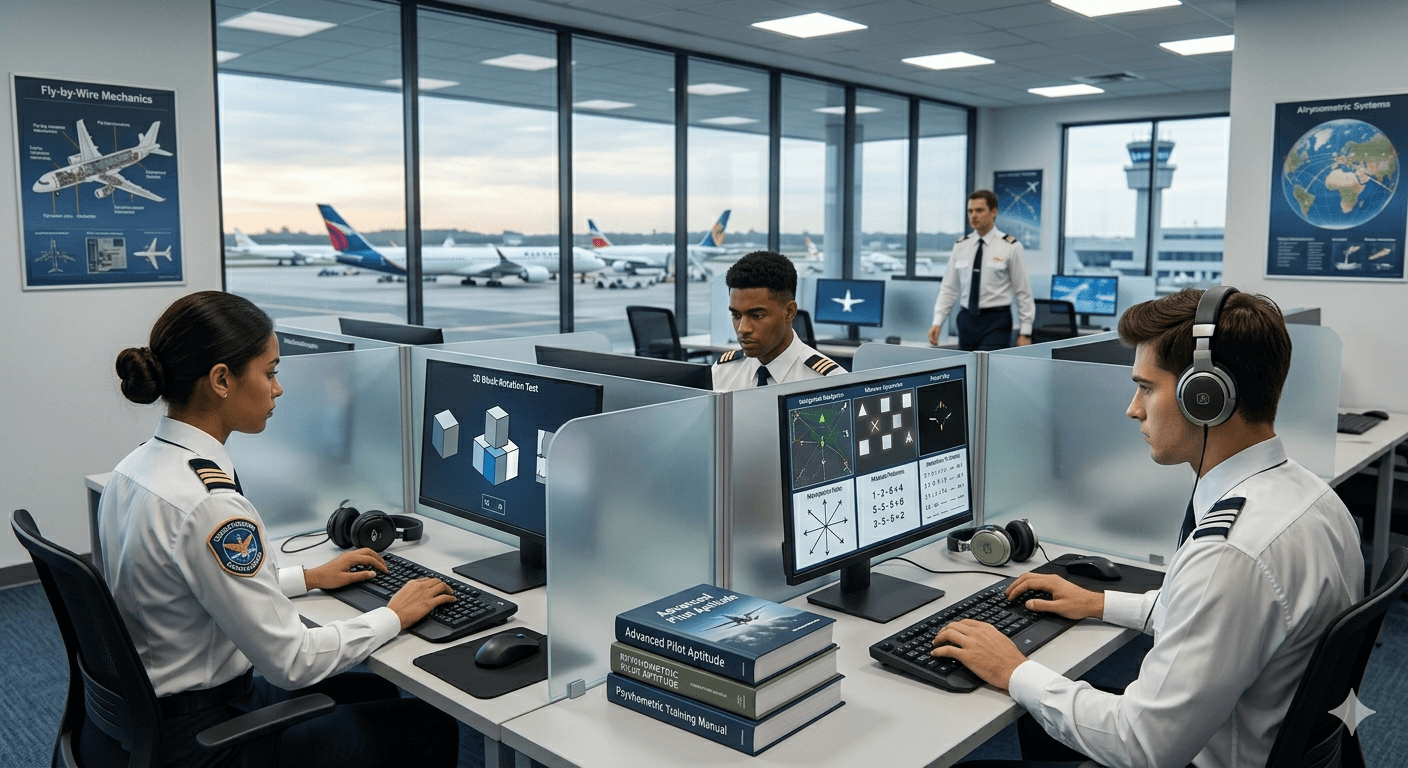
Are you dreaming of becoming a pilot by passing cadet pilot programs? Clearing the selection process for a cadet pilot program becomes highly competitive because they do not evaluate candidates based on strong academic performance and aviation knowledge. Modern airlines and flight training organizations select candidates through psychometric and aptitude tests, which evaluate candidates critical skills such as logical reasoning, multitasking ability, personality, decision-making skills, spatial awareness, and problem-solving capabilities.They conduct tests like ADAPT, COMPASS, group discussions, personal interviews, and simulator assessments to identify candidates who can perform in high-pressure situations. Many candidates fail to clear the selection process for a cadet pilot because they don’t know what these assessments test or how to prepare for them. This guide covers everything you need to know about psychometric & aptitude test preparation for cadet pilot programs and common mistakes to avoid during preparation.
What Are Psychometric Tests in Cadet Pilot Programs?
Psychometric tests are conducted in cadet pilot programs to evaluate candidates personality, behavioural patterns, teamwork, decision-making ability, and emotional stability. These tests help airlines to find candidates who are fit for these environments and take responsibility of airline operations.
Psychometric tests include:
Personality assessment: This assessment is included to evaluate the candidate’s behavioural traits and whether they are suitable for airline operations. This test checks candidates confidence, discipline, adaptability, decision-making style, and way of responding.
Situational judgement test: This test is included in the psychometric test to evaluate the decision-making and problem-solving skills of candidates. It checks how aspirants react during emergencies, conflicts, and challenging situations.
Multitasking ability: Professional pilots often have to manage multiple tasks at a time, such as communicating, navigating, and monitoring instructions. That’s why a multitasking test is conducted to assess information processing speed, concentration, coordination ability, and prioritization of tasks.
Communication behaviour: This test checks how effectively and clearly aspirants can communicate with others. Airlines look for candidates who are active listeners and communicate clearly and confidently, because professional pilots continuously have to communicate with crew members and air traffic control.
Leadership quality: This assessment checks candidates ability to take responsibility, make quick decisions, guide teams, and remain accountable during airline operations. Airlines prefer calm, supportive, and initiative-taking candidates.
Emotional stability: Emotional stability measures how candidates control their emotions during pressure or unexpected situations. This test evaluates candidates patience level, self-control, adaptability, and resilience.
Stress management capability: This area evaluates how they manage workload, handle pressure, and deal with unexpected situations.
Team collaboration skills: Professional pilots work closely with co-pilots, cabin crew, and operational teams. This assessment checks how candidates respect, cooperate, handle conflicts, and do teamwork.
What Are Aptitude Tests in Cadet Pilot Programs?
Aptitude tests are included in cadet pilot programs to measure candidates cognitive and operational skills before allowing them to proceed to further selection processes. Most of the Indian airlines organization use internationally recognised aptitude testing platforms like ADAPT, COMPASS, and FAST, which are designed to determine candidates trainability rather than their academic knowledge.
Aptitude tests assess:
Numerical reasoning and mental mathematics: This part is included in aptitude tests to evaluate candidates ability to solve mathematical calculations quickly and accurately without using calculators. They include questions from speed, distance, time, ratios, percentages, fuel consumption, basic trigonometry, and mental arithmetic.
Logical thinking: This test measures candidates problem-solving, analytical thinking, and decision-making skills. They may include pattern recognition, data interpretation, sequences, and logical puzzle questions.
Hand-eye coordination: This checks how candidates can respond to visual inputs while controlling equipment. They include joystick tasks, tracking exercises, and simulator-based activities.
Spatial orientation: It is included to evaluate the candidate’s ability to understand positions, directions, movements, and object relationships in space. They include questions about aircraft orientation, map reading, directional tracking, and object rotation.
Memory retention: These tests assess candidates short-term and working memory abilities, which are necessary for professional pilots to handle cockpit information. They may include symbols, recalling numbers, instructions, visual patterns, or sequences.
Information processing speed: This test measures how quickly candidates can analyse, understand, and respond to information. They may include identifying patterns, responding to multiple inputs at a time, or processing data.
Psychomotor performance test: This test helps to evaluate candidates coordination between mental processing and physical actions. It examines candidate reaction time, precision, operational performance, and multitasking ability.
What Are the Common Mistakes to Avoid During Preparation?
These are common mistakes to avoid during psychometric and aptitude test preparation to improve your performance and increase your chances of clearing the selection process of cadet pilot.
Skipping psychometric test preparation
Focus only on mathematics and academic questions
Poor time management during the preparation period
Overthinking about reasoning topics
Not practising in time-limited conditions
Not practising through mock tests
Start preparation too late for tests
Conclusion
If you want to enter the cadet pilot program, you have to prepare effectively for psychometric and aptitude tests, because the cadet pilot selection process is very competitive in India. If you are looking for guidance and support in preparation, contact Narain Aviation, which provides trained professionals to support candidates for the cadet pilot program preparations.
FAQs Regarding Psychometric and Aptitude Test Preparation For Cadet Pilot Programs:
What is included in pilot psychometric tests?
Pilot psychometric tests include personality assessments, multitasking ability, situational judgement, communication behaviour, and decision-making ability.
Which skills are required to pass cadet pilot aptitude tests?
It requires cognitive and operational skills such as numerical reasoning, logical thinking, spatial orientation, hand-eye coordination, multitasking ability, high information processing speed, and psychomotor abilities to pass cadet pilot aptitude tests.
How long does a candidate take to clear the cadet pilot selection process?
Many candidates take around 1 to 6 months to clear the selection process of cadet pilot programs, depending on assessment stages, airline, interview rounds, medical evaluations, and candidate preparations.
How can I prepare for cadet pilot aptitude tests?
You can prepare for aptitude tests through daily practice of aptitude questions, mock assessments, mental mathematics, simulator training, solving reasoning exercises, and psychometric preparation.
What is the main difference between the ADAPT and COMPASS tests?
The main difference between ADAPT and COMPASS tests is that ADAPT mainly focus on multitasking ability, psychomotor skills, and cognitive performance of candidates, while COMPASS focus on aptitude such as logical reasoning, mathematics problems, and coordination skills of candidates.
Fill the Details Below & Get a Free Guide on How to Become a Pilot.
He had served in the Meteorological Branch of the Indian Air Force for over 25 years. He not only has had years of experience in operational weather forecasting across the country but had also served in the capacity of Joint Director involving administrative and policy matters.
He was part of IPKF in Sri Lanka and served during various operations. He was actively involved in issuing timely forecasts for cyclones over Kutch and during earthquake at Bhuj.
He has deep knowledge of Meteorology and forecasting based on years of experience having served in most parts of the country. This practical knowledge mixed with years of teaching experience is very helpful in his current assignment.
Besides all of the above, he has had the opportunity of teaching Met for over five years to young trainee pilots at flying academies in Bidar and Hakimpet. At these places, young trainees from Fighter and Helicopter stream were trained to become pilots’ in the Indian Air Force.
A Squadron Commander in the IAF, she has handled the responsibilities of a Senior Air Traffic Controller, Radar Controller and a Duty Air Traffic Controller. She was the operational and administration head for more than 70 personnel in a squadron, which included officers and airmen.
Implementation of Airport procedures and enforcing field rules and regulations at diverse IAF bases with varied traffic conditions.
Successfully handled Aircraft operations as Senior Air Traffic controller at busy Air Force bases like Tezpur, Jodhpur, Bidar and Hakimpet which have complex flying environments, handling mixed traffic of defence as well as civil airplanes.
Successfully delivered results while working under challenging conditions and resource constraints. Possesses the ability to integrate and motivate diverse teams by creating positive work environment to facilitate high grade performance.
A retired fighter pilot, with versatile experience of 30 yrs. in the IAF, comprising Flying Training primarily, Operations and Flight Safety, apart from Surface to Air Missiles and Radars.
Over 17 yrs as a pilot, including second-in-command of a Flying Squadron. Total Flying of 2,350 hrs (4000 sorties), on Maruts, MiG-21s, Kirans, HT-2s and HPT-32s. Have force-landed aircraft without engine power twice, as a trainee (jet trainer aircraft) and as an Instructor (propeller trainer aircraft).
Qualified/Chief Flying Instructor twice at the Air Force Academy, 900 hrs instructional flying with trainees. Chief Ground Instructor at AF Stn Bidar, handling all Ground Training for flying
Commander of a Missile Squadron of 375 technical, operational and support personnel, for 3 yrs. Best Guided Weapons Squadron twice, 1997-98 and 1999-2000.
Director/Senior Flying Training Officer at HQ Training Command IAF, Bangalore for 5 yrs. Responsible for induction and operations of Hawk Advanced Jet Trainers and Flight Simulators at Bidar, Flying Instructors’ School at Tambaram and Surya Kiran Aerobatic Team (SKAT).
Qualified Flying Instructor, trained at Flying Instructors’ School, Tambaram, Chennai(1990) Second in Flying and fifth in overall merit at commissioning.
Air Marshal Ravinath Gururaj Burli (Retd) has a distinguished record of four decades of service. He has been an instructor at Flying Instructors School (FIS), Tactics And Combat Development Establishment (TACDE), Defence Services Staff College (DSSC).
He was Commandant at Air Force Academy (AFA), Dundigal, where he trained the young air force cadets learn flying training.
He brings his immense knowledge to train young students at our institute in Navigation, Instruments and Radio aids. His passion for teaching is amazing and fabulous.