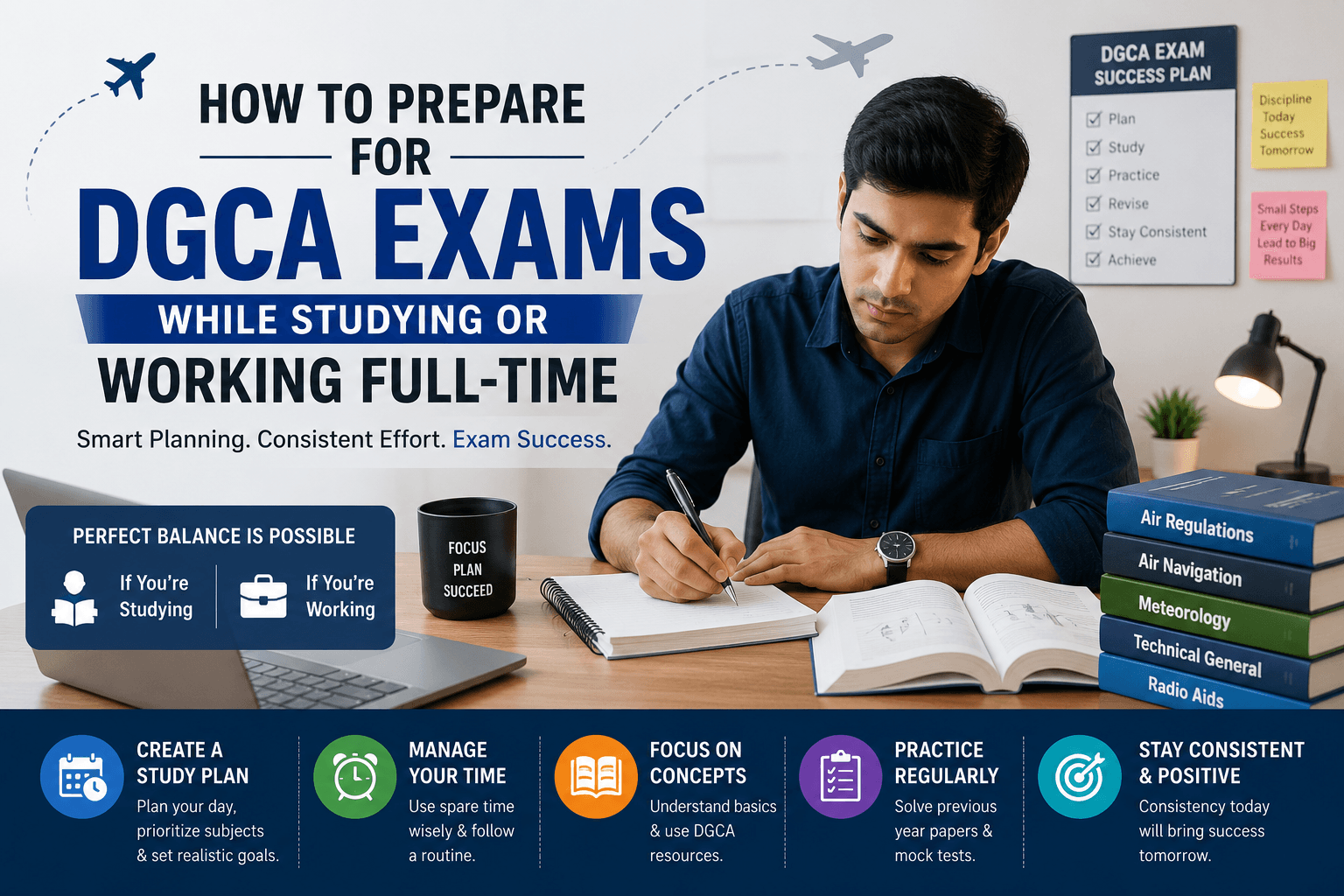
If you want to be a commercial pilot in India, you will need to pass the DGCA (Directorate General of Civil Aviation) exams before you can begin your career. For those who work full time or are still in school, there may not be enough time to adequately prepare for the DGCA exams. Working full-time and being a student while preparing for the DGCA will appear very difficult; it is achievable, however, with the correct strategy, discipline, and consistency.In this blog, we will talk about how to prepare for DGCA Exams While Studying or Working Full-Time
Before developing your study strategy, identify the subjects you need to study to clear the DGCA exams. The DGCA exams will normally consist of:
Air Navigation
Air Regulations
Aviation Meteorology
General Technical Subjects
Technical Subjects Specific to the Type of Aircraft You Will Be Flying.
Having a detailed understanding of the syllabus and the pattern of exams will assist you in determining how to execute your study plan and will also prevent you from wasting valuable time on studying non-essential material.
Develop an achievable study timetable
One of the biggest mistakes candidates make is setting unrealistic study goals for themselves. Rather than attempting to study 5 to 6 hours a day, have a set timetable that is consistent with your lifestyle and commitments.Examples of how to build your study timetable.
1-2 hours of study time each day on weekdays (5 days).
4-6 hours of study time each weekend (2 days).
Plan your schedule to allow time for review and mock testing weekly.
It is much more important to be consistent (in both the number of hours you study and the days you study) than it is to study long hours on occasion.
Utilize mornings or evenings earlier on.
Time to be productive is determined by your class schedule. If you’re going to be attending school in the afternoon, this would mean that your best time to study will be before class. If you’re working a 9-5, your most productive period will come in the evening after you have had time to rest when you get home.Studying one hour a day, distraction-free, is going to accumulate to a large number of hours over the course of months.
Study Topics in Priority Order by Weight
The weight of topics will vary which means that you will not be giving them equal effort in trying to complete them. The weight of a topic should dictate when you start studying for it (High or tough topic: start now; not very tough: wait and start later). A big subject should be broken down into smaller “bite-sized” portions so it can be less overwhelming than trying to learn all at once.Keeping a checklist of what you’ve done to help maintain motivation throughout your study sessions by keeping track of things that you have accomplished will help in finding that motivation.
Quality Study Material
Make sure to follow one or two study materials to avoid any burden or conflict. As for how to find quality material, only use study guides published by the DGCA. Use DGCA’s website to find organizations, up-to-date question banks of material, and to search out quality online courseware.Quality study materials will consist of good, clear explanations rather than having to memorise them.
Work On Previous Year Papers
Doing previous year exam papers will be a great way for you to prepare for your exams as it will enable you to:
Identify the types of questions that you will be asked.
Discover the types of questions that are frequently asked in the exam.
You should now how to manage your time to get best out of it to clear the DGCA exam.
Have confidence and assurance that you will complete the exam within the specified time.
Try working on old exams within the time frame of when you take your actual exam. This will help continue to create the testing environment that you will have on test day.
Take regular mock tests
Regularly taking preparation tests will give you insight into what type of study area you need to focus on. It will also help with speed and accuracy in taking tests. To learn from the mistakes you have made on each prep test you should spend equal amounts of time on reviewing your mistakes as you would on the next prep test.
Making the best use of your time gaps
If you are a student or working at a job then you should use random 10 to 20 minute breaks in a smart way for the following reasons:
To study your formulas.
To study your Air Regulations.
To study your flashcards.
To watch short concept videos related to studying.
Taking small time to study can improve the way you remember that information significantly after you have studied and this will help in passing your exam.
Avoid burnout by creating a balance
To avoid tiring out from trying to balance your preparational efforts with your job and/or school, you must follow a healthy routine:
Get 7 to 8 hours of sleep each night.
Take short breaks during study sessions.
Exercise regularly.
Eat healthy meals.
Limit the time you spend in front of a computer or phone before going to bed.A healthy mind will help you remember much more easily.
Consistency over perfectionism
Many candidates who are trying to study fail to continue when they skip studying for one or two days because they think they are so far behind now. If this is something happening to you just start back with your schedule the next business day after you missed.Also, studying consistently for 1 hour daily is going to be much more beneficial than trying to cram in ten hours of studying in 1 day each week.
Join the coaching or a group of experts
Become part of a group or class that provides quality instruction and assistance in preparing for specialized professional examinations offered by DGCA Coaching Institute. Learning with others will assist you in staying motivated, as well as in understanding topics that may be complicated. Many online debate communities or coaching institutions for DGCA offer the best mentors from the industry and have the best theoretical and practical training facilities. You will find your study to be less challenging with the assistance of others for the long haul.
Make a monthly plan
Instead of concentrating solely on the date of your examination, divide the study process into 12 months of goal setting. You can set a small goal for each month and then will be easily able to achieve the bigger goal in 10-12 months. Working towards many small objectives throughout the entire process will keep you motivated.
Stay Inspired
Preparing for an examination while also working or attending university may at times feel like it may be overwhelming; always remind yourself of the reason why you wanted to become a commercial pilot. Remember every time you finish a chapter or take a mock test you are one step closer to achieving your dream. Celebrate small successes and keep your confidence in your growth moving forward.
Blockquote
“Success in DGCA exams isn’t about studying the longest—it’s about studying consistently, understanding concepts, and revising smartly every day.
Conclusion
Make sure to plan for the DGCA exam in advance to get the best possible results. There is not an abundance of time required to study hundreds of hours per day—rather, the key to your successful study experience will be creating an effective study plan, obtaining reliable materials, and reviewing often. Following a simple daily routine can help you clear the exam easily without any stress.Narain Aviation is a top DGCA institute that provides the highest quality training for the DGCA exam. Feel free to learn more in detail about the courses and mentors.
Contact Details
Flying school – Narain AviationAddress – M-170, 2, 2nd Main Rd, East Of NGEF, Kasturi Nagar, Bengaluru, Karnataka 560043Contact – +91-9148402949WhatsApp – 919945225068E-mail – [email protected]Website – <ahref=”https://www.narainaviation.com/”>https://www.narainaviation.com/
Frequently Asked Questions
Can I prepare for my DGCA exams and work full-time?
It is possible to prepare for the DGCA exams while working full time. You have to be smart in managing your time. Daily consistent study of even 45 minutes to 1 hour can provide the best results.
How many hours do I need to study each day to prepare for my DGCA examinations?
Start by studying 40-60 minutes daily. This will build your endurance to study for more hours. Working employees should stick to 1 hour of daily studying consistently for 3-4 months or more before they appear in the exam.
What DGCA subject is deemed to be the hardest?
All subjects have their own importance. People have found air navigation to be the msot difficult subject.
Are coaching classes necessary to pass your DGCA examinations?
Coaching classes are highly beneficial in clearing the DGCA exam. They are experienced personnel who provide the relevant and on-target information to help you clear the exam.
How valuable are mock exams for preparing for your DGCA examinations?
Mock examinations will help you to increase your speed, accuracy, and familiarity with the pattern of the actual examination.
What strategy should I use to study or pass the DGCA exams?
Using concise notes, flash cards, and last year’s papers regularly is probably going to be your most effective method of studying and revising the syllabus.
Will I be able to pass my DGCA examinations on my first try?
It will always depend on your preparation. The majority of students pass in there first attempt. Choosing the right mentor institute for the DGCA exams is very crucial.
Should I read more than one book for each DGCA subject area?
It is always the best choice to choose one book or study material and study it 1-2 times to understand all the concepts.
Fill the Details Below & Get a Free Guide on How to Become a Pilot.
He had served in the Meteorological Branch of the Indian Air Force for over 25 years. He not only has had years of experience in operational weather forecasting across the country but had also served in the capacity of Joint Director involving administrative and policy matters.
He was part of IPKF in Sri Lanka and served during various operations. He was actively involved in issuing timely forecasts for cyclones over Kutch and during earthquake at Bhuj.
He has deep knowledge of Meteorology and forecasting based on years of experience having served in most parts of the country. This practical knowledge mixed with years of teaching experience is very helpful in his current assignment.
Besides all of the above, he has had the opportunity of teaching Met for over five years to young trainee pilots at flying academies in Bidar and Hakimpet. At these places, young trainees from Fighter and Helicopter stream were trained to become pilots’ in the Indian Air Force.
A Squadron Commander in the IAF, she has handled the responsibilities of a Senior Air Traffic Controller, Radar Controller and a Duty Air Traffic Controller. She was the operational and administration head for more than 70 personnel in a squadron, which included officers and airmen.
Implementation of Airport procedures and enforcing field rules and regulations at diverse IAF bases with varied traffic conditions.
Successfully handled Aircraft operations as Senior Air Traffic controller at busy Air Force bases like Tezpur, Jodhpur, Bidar and Hakimpet which have complex flying environments, handling mixed traffic of defence as well as civil airplanes.
Successfully delivered results while working under challenging conditions and resource constraints. Possesses the ability to integrate and motivate diverse teams by creating positive work environment to facilitate high grade performance.
A retired fighter pilot, with versatile experience of 30 yrs. in the IAF, comprising Flying Training primarily, Operations and Flight Safety, apart from Surface to Air Missiles and Radars.
Over 17 yrs as a pilot, including second-in-command of a Flying Squadron. Total Flying of 2,350 hrs (4000 sorties), on Maruts, MiG-21s, Kirans, HT-2s and HPT-32s. Have force-landed aircraft without engine power twice, as a trainee (jet trainer aircraft) and as an Instructor (propeller trainer aircraft).
Qualified/Chief Flying Instructor twice at the Air Force Academy, 900 hrs instructional flying with trainees. Chief Ground Instructor at AF Stn Bidar, handling all Ground Training for flying
Commander of a Missile Squadron of 375 technical, operational and support personnel, for 3 yrs. Best Guided Weapons Squadron twice, 1997-98 and 1999-2000.
Director/Senior Flying Training Officer at HQ Training Command IAF, Bangalore for 5 yrs. Responsible for induction and operations of Hawk Advanced Jet Trainers and Flight Simulators at Bidar, Flying Instructors’ School at Tambaram and Surya Kiran Aerobatic Team (SKAT).
Qualified Flying Instructor, trained at Flying Instructors’ School, Tambaram, Chennai(1990) Second in Flying and fifth in overall merit at commissioning.
Air Marshal Ravinath Gururaj Burli (Retd) has a distinguished record of four decades of service. He has been an instructor at Flying Instructors School (FIS), Tactics And Combat Development Establishment (TACDE), Defence Services Staff College (DSSC).
He was Commandant at Air Force Academy (AFA), Dundigal, where he trained the young air force cadets learn flying training.
He brings his immense knowledge to train young students at our institute in Navigation, Instruments and Radio aids. His passion for teaching is amazing and fabulous.