Once you made your decision to want to be a pilot for a career, this was easy. The hardest part is the journey to becoming a pilot while trying to avoid wasting months or years of your time on mistakes that could; These are some examples of common mistakes that delays people throughout the journey to becoming a pilot, your navigation skills are required for each type of mistake you may encounter along the way to becoming a pilot.So in this blog we give you proper information about mistakes that delay your commercial pilot journey and how to avoid them. So stay tuned with this blog.
The DGCA Computer Number is not just a mark on the way to pass. It is your only way into each and every subsequent exam and also license step. Many Students that have delayed applying for DGCA Computer Number until later have experienced a minimum of 2 weeks of lost time from process and corrective requests. You should apply as early as you can, check each field twice, have your documents together, and ready for submission before completing Class 12.
2. Skipping the Medical Exam Until the Last Minute
If your medical condition is discovered late it can completely delay all of your plans. You therefore should get your medical completed as early in training as possible and not when you have already booked international flying hours.
3. Choosing a Training Institute Without Checking Its Track Record
One of the biggest reasons students find themselves repeating a stage or having to search for another academy during the course is that they often choose a flight training school because of price rather than on the basis of instructor experience and placement history. Unfortunately, not all of the flight schools will provide you with an experience that meets the requirements of the DGCA.
4. Poor Planning Around the 200 Flying Hours
A number of students do not approach their flying hours requirements methodically. They have no formal plan regarding how they will acquire cross-country time, night flying time, or instrument time. This can cause delays in schedule and additional costs for flying outside of the country.
5. Underestimating ADAPT/COMPASS and Interview Preparation
You may think that just passing your ground exams is a job well done; however, the airline psychometric tests or interviews may be the reason why you didn’t get a seat after several years of hard work and effort. The loss of a position may be due to failing to practice with a structured simulator or attend a mock interview.
6. Not Planning Finances Early
Pilot training is a significant financial commitment, and trying to obtain loan financing after beginning your training may result in delays in your flight training. By arranging your financial support (and appropriate documentation) before starting your training, you are less likely to experience disruptions in your training schedule.
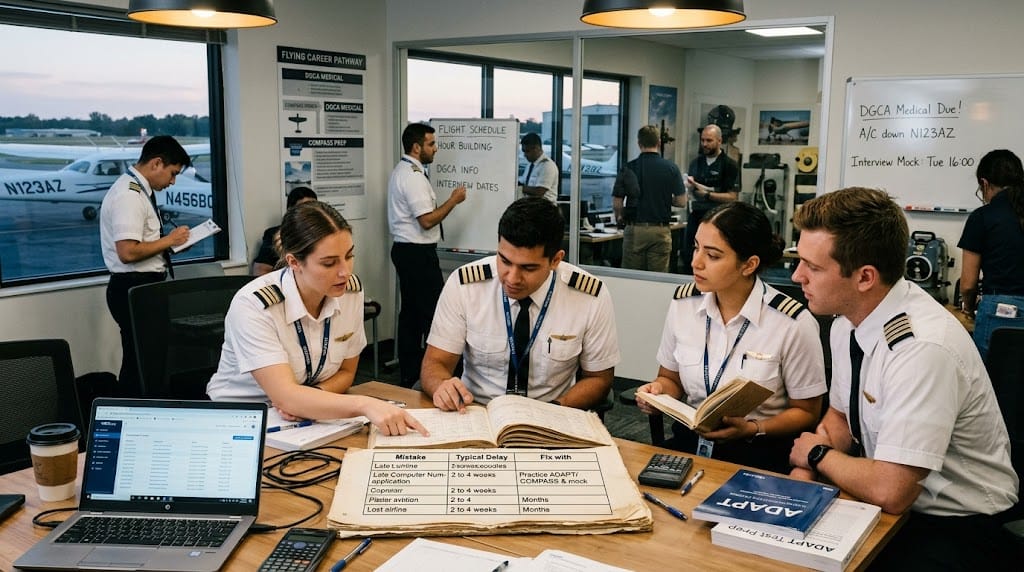
Quick Comparison: Common Mistakes vs. Their Fix
Mistake
Typical Delay
Fix
Late Computer Number application
2 to 4 weeks
Apply immediately after class 12
Ignored medical issues
Months
Complete medical early
Wrong institute choice
6+ months
Verify DGCA compliance & track record
Unstructured flying hours
Weeks to months
Follow a planned hour buliding schedule
Skipped interview prep
Lost airline
Practice ADAPT/COMPASS & mock
Late loan planning
Weeks
Arrange financing before training starts
The Bottom Line
The majority of delays to commercial pilot journeys aren’t attributable to ability, but rather a lack of planning. In many cases, if you work with an appropriate training partner and get all of your paperwork, medicals, and interview preparation completed promptly, many delays could be avoided. Narain Aviation has assisted more than 1,000 professionally trained pilots in following a structured, DGCA compliant, path (ground school to airline placement) and has provided students with tools to avoid these types of delays.If you wish to become a commercial pilot but don’t want to waste time due to preventable mistakes, please contact Narain Aviation to begin your journey in the best way possible.
FAQs
I just finished Class 12 — am I already behind if I haven’t started anything yet?
Definitely not! A lot of schools are just starting up in (about) this time of year too. The most important thing is to do this in a timely manner, and not wait months before doing the DGCA’s CMD, as that will be the step that most people mistakenly take later than they should, costing them valuable time in the process.
What if I fail my medical exam — does that mean I can’t become a pilot?
Not always true; however, there are many pre-existing medical conditions that may disqualify you from obtaining health insurance internationally, but can be managed, treated or reconsidered later on. The biggest mistake, though, is when you find out about one of these pre-existing medical conditions after you have already invested money and time travelling to another country and can’t be offered a policy at all. Get a screening done early, so that you know what your options are.
How do I know if a flying academy is actually good, or just good at marketing?
Inquire about your future employer’s past history with the DGCA by looking at their instructors’ backgrounds as well. Speak directly to alumni of those employers concerning their timeline and placement results. A low price without any evidence to support that price could end up costing you in the long term — both financially and in terms of lost opportunities.
Is it normal for the 200 flying hours to take way longer than expected?
Proper planning should eliminate delays. When hour-building is not effectively structured in advance, that’s when most of the delays occur. For example, logistics for cross-country flying, night flying and instrument flying need to be done specifically prior to flying and not made up as you go along (pun intended).
I’m good at the technical exams — do I still need to prepare for ADAPT or COMPASS?
Certainly, there are a large number of individuals who make this mistake. Just being strong on paper does not mean you will perform well in a psychometric simulator or interview. A few structured hours of practice could make the difference between receiving an offer from the agency that interviewed you for the position or not.
Fill the Details Below & Get a Free Guide on How to Become a Pilot.
He had served in the Meteorological Branch of the Indian Air Force for over 25 years. He not only has had years of experience in operational weather forecasting across the country but had also served in the capacity of Joint Director involving administrative and policy matters.
He was part of IPKF in Sri Lanka and served during various operations. He was actively involved in issuing timely forecasts for cyclones over Kutch and during earthquake at Bhuj.
He has deep knowledge of Meteorology and forecasting based on years of experience having served in most parts of the country. This practical knowledge mixed with years of teaching experience is very helpful in his current assignment.
Besides all of the above, he has had the opportunity of teaching Met for over five years to young trainee pilots at flying academies in Bidar and Hakimpet. At these places, young trainees from Fighter and Helicopter stream were trained to become pilots’ in the Indian Air Force.
A Squadron Commander in the IAF, she has handled the responsibilities of a Senior Air Traffic Controller, Radar Controller and a Duty Air Traffic Controller. She was the operational and administration head for more than 70 personnel in a squadron, which included officers and airmen.
Implementation of Airport procedures and enforcing field rules and regulations at diverse IAF bases with varied traffic conditions.
Successfully handled Aircraft operations as Senior Air Traffic controller at busy Air Force bases like Tezpur, Jodhpur, Bidar and Hakimpet which have complex flying environments, handling mixed traffic of defence as well as civil airplanes.
Successfully delivered results while working under challenging conditions and resource constraints. Possesses the ability to integrate and motivate diverse teams by creating positive work environment to facilitate high grade performance.
A retired fighter pilot, with versatile experience of 30 yrs. in the IAF, comprising Flying Training primarily, Operations and Flight Safety, apart from Surface to Air Missiles and Radars.
Over 17 yrs as a pilot, including second-in-command of a Flying Squadron. Total Flying of 2,350 hrs (4000 sorties), on Maruts, MiG-21s, Kirans, HT-2s and HPT-32s. Have force-landed aircraft without engine power twice, as a trainee (jet trainer aircraft) and as an Instructor (propeller trainer aircraft).
Qualified/Chief Flying Instructor twice at the Air Force Academy, 900 hrs instructional flying with trainees. Chief Ground Instructor at AF Stn Bidar, handling all Ground Training for flying
Commander of a Missile Squadron of 375 technical, operational and support personnel, for 3 yrs. Best Guided Weapons Squadron twice, 1997-98 and 1999-2000.
Director/Senior Flying Training Officer at HQ Training Command IAF, Bangalore for 5 yrs. Responsible for induction and operations of Hawk Advanced Jet Trainers and Flight Simulators at Bidar, Flying Instructors’ School at Tambaram and Surya Kiran Aerobatic Team (SKAT).
Qualified Flying Instructor, trained at Flying Instructors’ School, Tambaram, Chennai(1990) Second in Flying and fifth in overall merit at commissioning.
Air Marshal Ravinath Gururaj Burli (Retd) has a distinguished record of four decades of service. He has been an instructor at Flying Instructors School (FIS), Tactics And Combat Development Establishment (TACDE), Defence Services Staff College (DSSC).
He was Commandant at Air Force Academy (AFA), Dundigal, where he trained the young air force cadets learn flying training.
He brings his immense knowledge to train young students at our institute in Navigation, Instruments and Radio aids. His passion for teaching is amazing and fabulous.
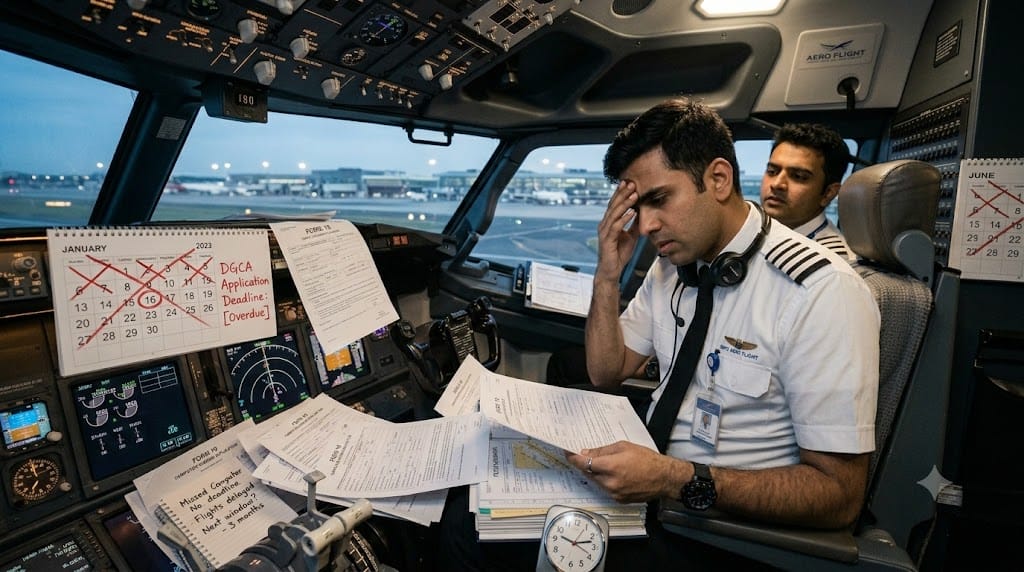 The DGCA Computer Number is not just a mark on the way to pass. It is your only way into each and every subsequent exam and also license step. Many Students that have delayed applying for DGCA Computer Number until later have experienced a minimum of 2 weeks of lost time from process and corrective requests. You should apply as early as you can, check each field twice, have your documents together, and ready for submission before completing Class 12.
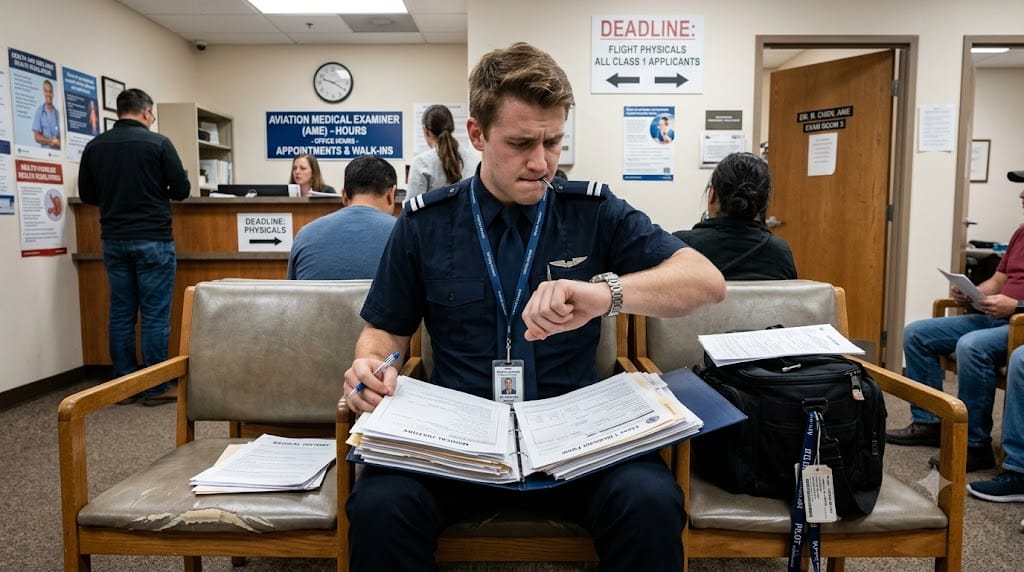 If your medical condition is discovered late it can completely delay all of your plans. You therefore should get your medical completed as early in training as possible and not when you have already booked international flying hours.
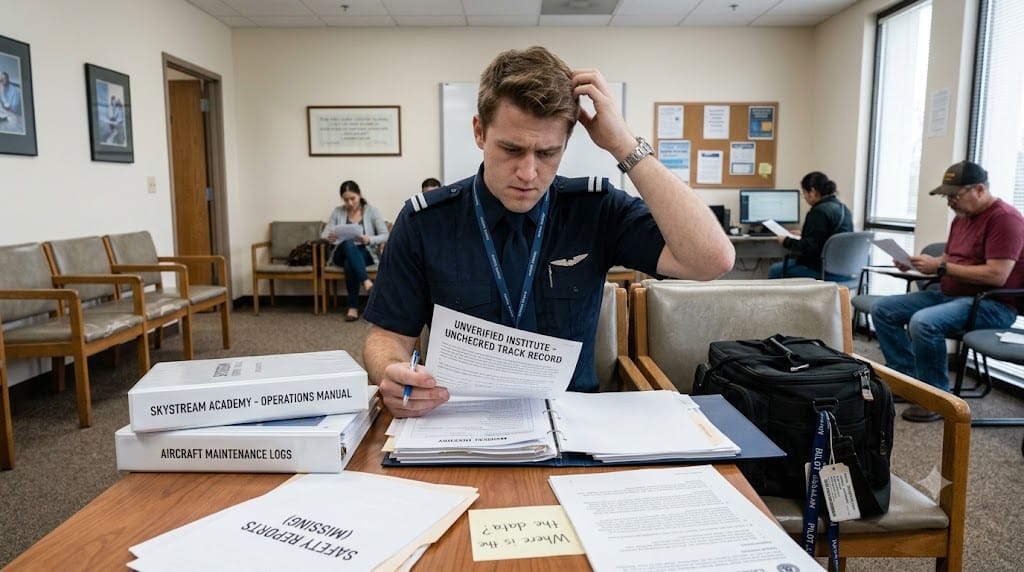 One of the biggest reasons students find themselves repeating a stage or having to search for another academy during the course is that they often choose a flight training school because of price rather than on the basis of instructor experience and placement history. Unfortunately, not all of the flight schools will provide you with an experience that meets the requirements of the DGCA.
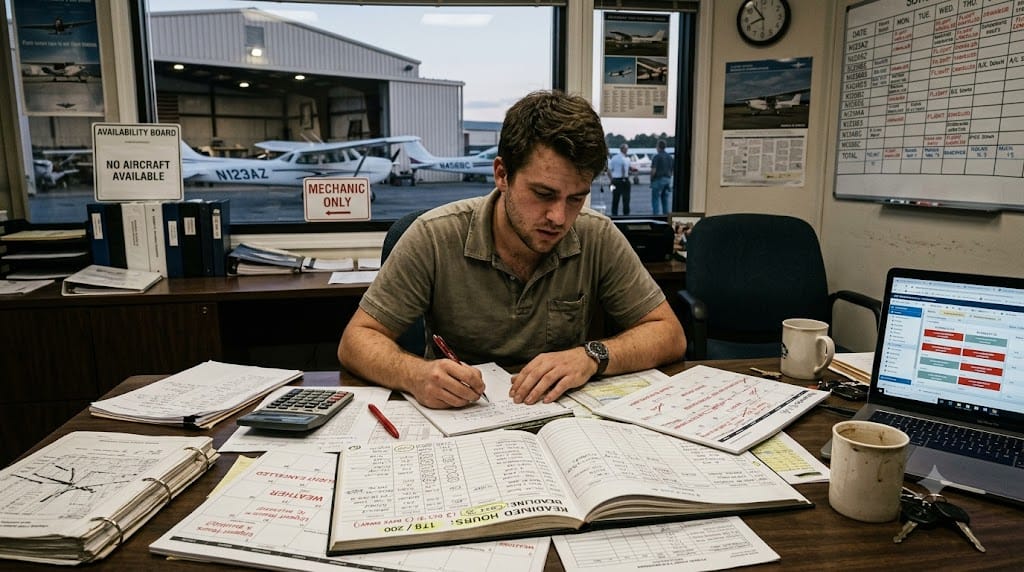 A number of students do not approach their flying hours requirements methodically. They have no formal plan regarding how they will acquire cross-country time, night flying time, or instrument time. This can cause delays in schedule and additional costs for flying outside of the country.
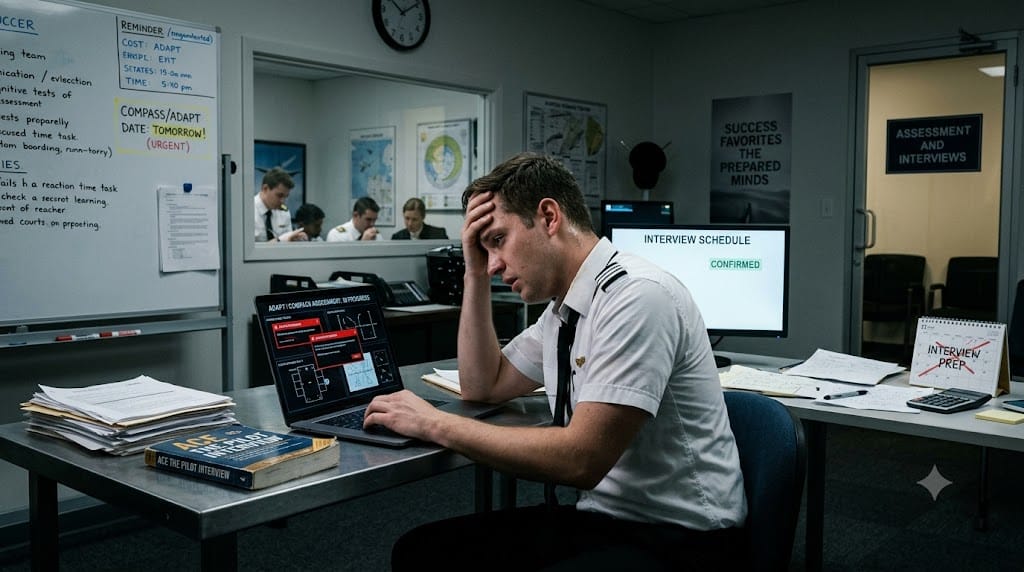 You may think that just passing your ground exams is a job well done; however, the airline psychometric tests or interviews may be the reason why you didn’t get a seat after several years of hard work and effort. The loss of a position may be due to failing to practice with a structured simulator or attend a mock interview.
 Pilot training is a significant financial commitment, and trying to obtain loan financing after beginning your training may result in delays in your flight training. By arranging your financial support (and appropriate documentation) before starting your training, you are less likely to experience disruptions in your training schedule.